

From the perspective of sustainable development, it is advisable to reserve more than 10 cable channels in the Cable Tray. On the basis of meeting the cross-sectional requirements for cable arrangement, the selection of general steel truss structures for 30m and 40m span cable trays can meet the requirements for bearing capacity and stiffness. It is recommended to use a prestressed steel truss structure system for cable trays with a span of over 40m, which can lower the height of the truss section.
The working condition that controls the bearing capacity of the truss is the combination of dead load and live load. Therefore, for simply supported prestressed steel trusses, the double line prestressing arrangement method is more effective. Later, some suggestions for standardization were put forward.
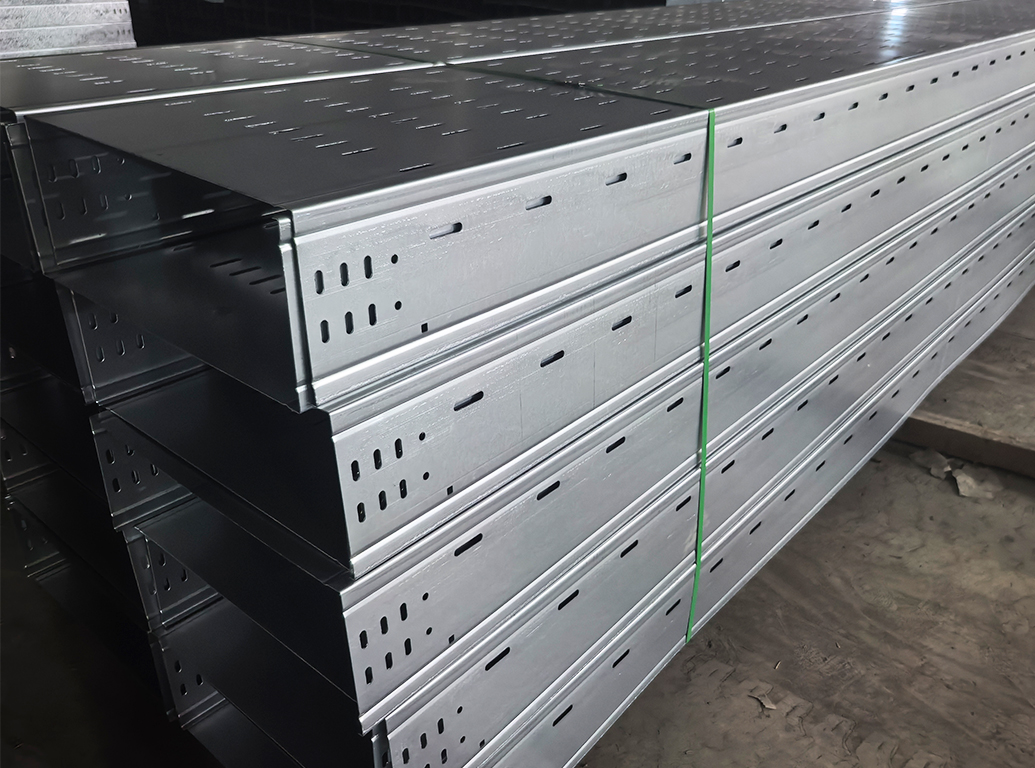
With the rapid growth of the national economy, the demand for power supply in various regions has further advanced. However, due to the large-scale development of land, it is often difficult to select transmission line routes, and high-voltage power cables often cross rivers. When crossing wider rivers, cable tray structures are commonly used, among which concrete aqueducts and steel structure trays are commonly used. The concrete culvert bridge scheme requires formwork to be set up on the river surface to pour groove concrete and protect it from forming. The disadvantage is that formwork support is difficult, the construction period is long, and the construction difficulty is high. If constructed on the waterway, it will affect navigation for a long time and be greatly affected by the season and local shipping traffic conditions.
Nowadays, the planning and construction technology of steel structures is becoming increasingly advanced. The use of steel structure cable trays can directly cross large spans without the need to set up support points in the middle of the river, and the construction speed is fast.
The snow load is considered to be a large value that occurs once every 50 years in Jiangsu Province, 0.65kN/m2 (Nanjing City); Earthquake effect: The earthquake effect is considered in two cases: 7 degrees (0.10g) and 8 degrees (0.2g). The planned earthquake grouping is based on the first group, and the soil type of the site is Class III. 8 degrees (0.3g) only appears in Sucheng and Suyu in Suqian. Based on practical experience, a detailed analysis of the situation is needed. At 7 degrees, only the horizontal seismic effect is considered, while at 8 degrees, the vertical seismic effect of steep water needs to be considered together.


Copyright © 2026 Hebei Xinnin Metal Products Co., Ltd
Mapa del sitioEste sitio web utiliza cookies para garantizar que obtenga la mejor experiencia en nuestro sitio web.
 English
 한국어
한국어 العربية
 ไทย
ไทย



 Teléfono
Comentario
(0)